


What is Melasma?
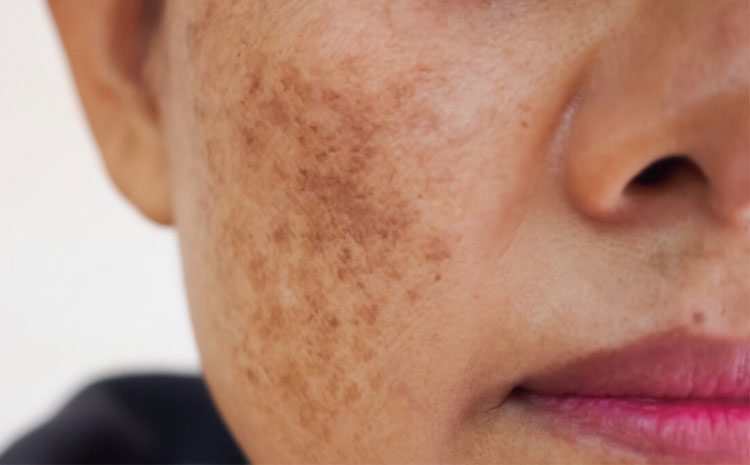
Melasma (derived from the Greek word melas) is an acquired pigmentary condition of sun-exposed skin, often manifesting as dark patches.
Another term is chloasma, which is often used to describe Melasma developing during pregnancy.
How does one get Melasma? What are the predisposing factors for Melasma?
The exact cause of Melasma is not yet clear. It likely occurs when the colour-making cells in the skin (melanocytes) of the affected areas produce too much pigment.
Common contributory factors include:
- Sun exposure
- Pregnancy
- Drugs such as phenytoin, oral contraceptive pills, or hormone replacement therapy
- Family history
- Hypothyroidism and thyroid autoimmunity
How does Melasma appear?
- Melasma appears more commonly in women than men.
- It presents as brown, grey, or black patches on sun-exposed areas.
- Common sites: cheeks, forehead, upper lip, nose, and chin — usually in a symmetrical pattern.
- Sometimes limited to the cheeks and nose area.
- Other sun-exposed areas such as the neck and forearms are less commonly affected.
- The skin lesions are not itchy but can cause significant cosmetic concern.
What should one do if he/she gets Melasma?
- All dark patches on the face are not Melasma — proper diagnosis is essential.
- Consult a dermatologist for confirmation and appropriate treatment.
- Self-medication with steroid-containing creams should be strictly avoided.
Are there any tests to confirm Melasma?
- Melasma is usually diagnosed by the clinical appearance of the lesions.
- A dermatologist may confirm it using a Wood’s lamp or dermatoscope.
- Occasionally, a skin biopsy may be done to differentiate it from other pigmentary conditions.
How can Melasma be treated?
Melasma responds poorly to treatment. Generally, sun protection measures along with a combination of topical, oral, and procedural treatments are helpful.
General Measures
- Year-round, lifelong sun protection is essential.
- Use a broad-spectrum SPF 50+ sunscreen daily, applied to the whole face.
- Reapply every 2 hours if outdoors during summer.
- Alternatively, use make-up containing sunscreen and wear a broad-brimmed hat.
- Discontinue hormonal contraception, if possible.
- Camouflage creams may help reduce the cosmetic concern.
Topical Treatments
- Various skin-lightening creams are used in Melasma.
- Hydroquinone (2–4%) formulations applied to pigmented areas at night for 2–4 months can be useful.
- The most effective formulation combines hydroquinone, tretinoin, and a moderate potency steroid — showing improvement in 60–80% of cases.
- New agents under investigation include:
- Zinc sulfate
- Mequinol
- Resveratrol
- 4-hydroxy-anisole
- 2,5-dimethyl-4-hydroxy-3(2H)-furanone
- N-acetyl glucosamine
- Methimazole
Oral Treatments
- Oral medications under investigation include tranexamic acid and glutathione.
Procedural Treatments
- Chemical Peels: Glycolic acid and lactic acid peels.
- Laser Therapy: Q-switched Nd:YAG, Q-switched ruby, Alexandrite, IPL, CO2, and erbium:YAG lasers.
- Mechanical Treatments: Dermabrasion and microdermabrasion.
- These are used in resistant or recurrent cases.
Can Melasma be cured? Can Melasma recur?
- Melasma cannot be completely cured, but multiple treatment options can improve its appearance.
- Melasma tends to recur, especially if sun protection measures are not adequately followed.
Disclaimer: This article is only for general patient information and is not intended for self-medication. There is no legal liability of IADVL arising out of any adverse consequence to the patient. Subsequent to its use for self-treatment of the disease, images are adjusted for the depiction of the condition and are not to be used for any other purpose.
